
Past & Present Enemies: When Titus Comes to Town
There are places where history feels safely buried beneath the stones.
And then there are places where the past refuses to stay in the past.
Standing in Rome before the Arch of Titus is one of those moments.
This ancient monument has survived for nearly two thousand years. Tourists walk beneath it. Cameras point toward its carved reliefs. Visitors admire the architecture and continue toward the Roman Forum and Colosseum.
But when I stand before it as a Jew from Israel, I see something different.
I see a monument connected to one of the most devastating chapters in the history of my people.
And I find myself standing face-to-face with Titus.
Standing Face-to-Face With Titus
The Arch of Titus commemorates the Roman victory following the Jewish revolt and the destruction of Jerusalem in 70 CE.
Its famous relief depicts Roman soldiers carrying spoils associated with the Jerusalem Temple, including the menorah.
For most visitors, this is ancient history.
For me, it is personal.
As I walked through Rome, I found myself staring at monuments representing an empire that once brought enormous destruction upon Judea.
The Romans crushed the revolt. Jerusalem was devastated. The Second Temple was destroyed. Jewish captives were taken.
And yet, almost two thousand years later, here I was.
A Jew.
An Israeli.
Standing in Rome looking back at Titus.
That contrast is difficult to ignore.
The Roman Empire that celebrated its victory is gone.
The Jewish people are still here.
Did Jewish Captives Build the Colosseum?
Walking through Rome also brought me face-to-face with stories many of us grew up hearing.
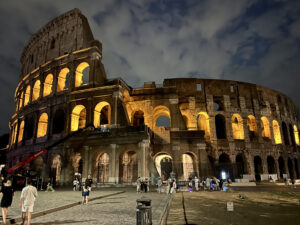
One of those stories says that Jewish captives brought to Rome after the destruction of Jerusalem helped build the Colosseum.
Standing before it, I found myself thinking about that story again.
Jewish tradition and collective memory have often connected our ancestors with the great monuments of the civilizations that conquered us.
We tell similar stories about Egypt.
Were Jewish slaves responsible for constructing these enormous monuments?
History is usually more complicated than the stories passed from generation to generation.
But sometimes the deeper meaning of those stories is not simply about who physically carried a stone.
It is about memory.
It is about how a people remembers captivity, exile and survival.
And Rome is filled with reminders of all three.
A Monument Built to Celebrate Defeat
The Arch of Titus is particularly powerful because its meaning is not ambiguous.
It celebrates Roman victory.
Titus returned to Rome after the campaign in Judea, and the triumph became part of Roman imperial memory.
The arch became a permanent symbol of that victory.
Imagine what that means from the perspective of the defeated people.
Imagine walking toward a monument built by an empire that celebrated the destruction of your ancestors’ world.
That was the thought running through my mind.
But there was another thought too.
The arch is still here.
And so are we.
The meaning of a monument can change depending on who is standing before it.
To Rome, it represented victory.
To me, nearly two thousand years later, it also represents survival.
Rome Is Beautiful — And That Makes the Moment Stranger
Perhaps the strangest part of this experience was that Rome itself was wonderful.
Shortly before visiting these ancient monuments, I was sitting at a café.
I had pasta.
I drank coffee.
I had tiramisu.
Across from me stood a beautiful church in one of the world’s great cities.
And suddenly I became emotional.
Because only a short time before arriving in Italy, I had been back home in Israel.
The contrast between enjoying contemporary Rome and thinking about war, history, family and home hit me unexpectedly.
That is one of the strange things about travel.
Sometimes you travel thousands of miles only to understand something about the place you came from.
Rome wasn’t simply showing me Roman history.
It was making me think about Israel.
It was making me think about Jewish history.
And it was making me think about what it means for a people to survive history.
When Ancient History Stops Feeling Ancient
It is easy to place Rome in a comfortable historical category.
Romans.
Legions.
Emperors.
Ancient wars.
Ruins.
But standing beside the Arch of Titus, those words stop feeling entirely academic.
You begin thinking about actual people.
Families.
Communities.
Soldiers.
Captives.
People who watched their world collapse.
Amir’s reflection in When Titus Comes to Town moves deliberately between that ancient history and his experience of modern Israel.
Those comparisons are personal and, at times, confrontational. They reflect his own interpretation of Jewish history and the conflicts of the present.
But underneath that anger is a larger question:
What does survival mean?
The Empire Became Ruins
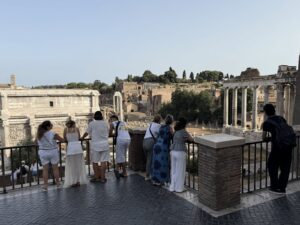
Walk through the Roman Forum today and you are walking through the remains of what was once one of the most powerful political and military systems on Earth.
Columns stand without buildings.
Temples survive as fragments.
Stones mark places where emperors once exercised extraordinary power.
The Roman Empire once appeared permanent.
It wasn’t.
History has a habit of reminding us that power is temporary.
Empires rise.
Empires fall.
Borders change.
Armies disappear.
Monuments become archaeological sites.
And people who once seemed destined to disappear sometimes remain.
That is what struck me most deeply in Rome.
The Arch Is Still There. So Are We.
There is something extraordinary about standing before a monument commemorating the defeat of your ancestors while knowing that their descendants survived.
Jewish history after Rome was hardly easy.
There were centuries of dispersion, persecution, displacement and repeated upheaval.
And yet Jewish culture continued.
Jewish traditions continued.
Hebrew survived and was revived as a modern spoken language.
Jewish communities continued to tell their stories.
And today, Jews once again live in the ancient Jewish homeland.
For me, standing at the Arch of Titus transforms the monument.
It no longer tells only the story its builders intended.
The Romans wanted to commemorate victory.
Time added another chapter.
The people represented as defeated on that monument did not disappear.
What Does the Arch Mean Today?
Perhaps that is why ancient places matter.
They allow us to stand physically between different moments in time.
You can look at the same stone seen by generations before you and ask an entirely different question.
What did this monument mean when it was built?
What did it mean one thousand years later?
And what does it mean now?
For a Roman citizen in antiquity, the Arch of Titus represented imperial triumph.
For a modern tourist, it may represent extraordinary Roman art and architecture.
For a Jewish visitor, it can carry another layer entirely.
Loss.
Exile.
Memory.
And survival.
All of those meanings can exist around the same stones.
Past and Present
The title of this episode is Past & Present Enemies: When Titus Comes to Town because standing before Titus inevitably creates a conversation between history and the present.
Amir does not approach that conversation as a detached historian.
He approaches it as someone whose identity, family, homeland and understanding of history are deeply connected to the story he is describing.
That makes the episode personal.
Sometimes uncomfortable.
Sometimes angry.
But travel does not always have to be comfortable.
The most meaningful journeys often happen when a place forces us to confront questions we did not expect to ask.
Who were the victors?
Who were the defeated?
Who disappeared?
Who remained?
And who gets to tell the story two thousand years later?
Journeys With Meaning
At Shalom Carmel, we believe travel becomes more powerful when a destination becomes more than scenery.
A stone is never just a stone.
A vineyard is never only a vineyard.
A ruin is never simply a ruin.
Behind every landscape are generations of people, stories, conflicts, traditions and memories.
Rome offers magnificent architecture, extraordinary food and some of the greatest historical sites on Earth.
But viewed through Jewish eyes, it can also become something else:
A place to think about Jerusalem.
A place to think about Judea.
A place to think about exile.
And ultimately, a place to think about survival.
Standing before the Arch of Titus, I could look at the monument Rome created to remember its victory.
But I could also look around and recognize something its builders could never have known.
Nearly two thousand years later, someone descended from the people Rome defeated would stand before their arch and tell the story from the other side.
The stones remain.
The story continues.
And so do we.
Watch: Past & Present Enemies — When Titus Comes to Town
Join Amir Katz in Rome as he walks through the Roman Forum, stands before the Arch of Titus and reflects on the destruction of ancient Judea, Jewish memory, modern Israel and what it means for a people to survive the rise and fall of empires.
Watch the full episode on the Shalom Carmel YouTube channel.
Shalom Carmel — Wisdom & Adventures
Tours. Talks. Tastings.
Related posts

When Judea Visits Roma: A Stop in the Lion’s Den, on the Road Home
There are a handful of women in my life who hear the words “Amir is traveling” and immediately hold their breath. My mother. My grandmother. My great-grandmother, once upon a time. My daughter Gaia, who these days gives Poppy a particularly stern look when I announce...

A Perfect Day on a Carmel Wine Tour: Vineyards, Views & Mediterranean Magic
There are few places in Israel where mountain, vineyard, coastline, and history exist in such effortless harmony as they do in the Carmel region. A Carmel wine tour is not simply about tasting wine — it is about moving through a landscape shaped by centuries of...
Wine Tour in Carmel, Israel: Where Every Glass Tells a Story
There are wine regions that impress you.And then there are wine regions that surprise you. The Carmel region of Israel does both. Tucked between mountain slopes and the Mediterranean coastline, the Carmel is one of the country’s most historic and exciting wine...
0 Comments